

For entrepreneurs, SMB owners, and SaaS evaluators in 2026, Todoist stands out as an ultra-reliable, intuitive task management solution that helps individuals and teams transition from chaos to clarity. Its cloud-native design, flexible integrations, and effortless cross-platform UX make it the gold standard for managing daily work and life projects with sustainable, real-world results.
From Launch to 2026: Todoist’s Evolution
- 2010–2014: Began as a simple to-do app, prioritizing user-friendly task capture.
- 2015–2018: Expanded with robust project management, reminders, and cross-device sync.
- 2019–2022: Surpassed 25M users, launched advanced templates, productivity streaks, and deep integrations.
- 2023–2026: Focus shifted to AI-powered smart suggestions, seamless team collaboration, and industry-grade security. Todoist cements its lead as an enterprise-ready but approachable task hub for growing companies and career-oriented individuals alike.
Key Features
- Trusted Second Brain: Powerful capture and organization for everything from daily tasks to strategic projects.
- Cross-Platform Access: Top-rated apps, extensions, and widgets work on any device—desktop, mobile, or web.
- Intelligent Scheduling: Natural-language task entry lets you set recurring tasks by typing “Submit report every Friday.”
- Advanced Customization: Filters, labels, priorities, and templates to match your exact workflow.
- Team Collaboration: Assign tasks, add comments, set deadlines, and coordinate with up to 50 collaborators per project.
- Deep Integrations: Seamlessly connects with Google Calendar, email, Slack, voice assistants, and 90+ other tools.
- Templates & Methodologies: Accelerators for popular productivity frameworks (GTD, Kanban, daily planning, etc.).
- Mobility: Native iOS, Android, Mac, Windows, and even browser extensions to manage tasks anywhere.
- Security & Compliance: GDPR-ready, enterprise-grade data protections in all paid plans.
Workflow & User Experience
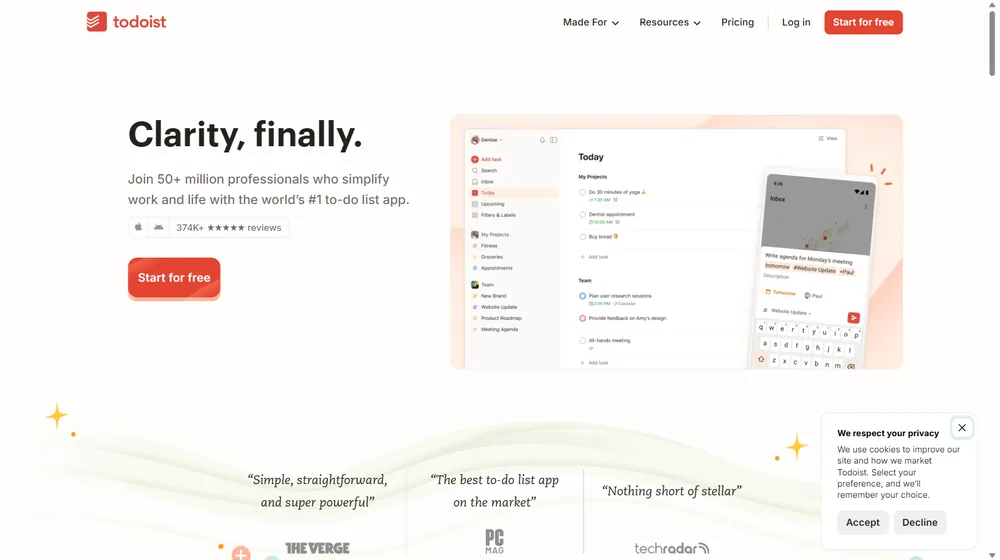
- Lightning-fast task entry, color-coded priorities, and intuitive drag-and-drop interface.
- Calendar and inbox views help users focus on today, upcoming, or project-anchored lists.
- Collaboration tools enable easy delegation, sharing, and commenting—without the bulk of legacy PM platforms.
- Progress tracking: visual productivity streaks and karma points encourage consistency and effectiveness.
- Support: self-serve help center, documentation, and email/web support for all users; priority support for teams.
Todoist Pricing
| Plan | Key Features | Pricing (USD) |
|---|---|---|
| Free | Up to 5 projects Basic reminders and limited collaborators |
$0 |
| Pro | 300 projects 25 collaborators Advanced reminders, filters, labels, themes |
$5/mo (billed annually); $7/mo (monthly) |
| Teams | 500 projects/team 50 collaborators per project Team management, admin features, billing controls |
$8/mo per member (billed annually); $10/mo (monthly) |
Todoist vs Competitors
| Product | Core Differences | Best For |
|---|---|---|
| Todoist | Balanced simplicity and power, best-in-class natural language entry, cross-platform, excellent free/Pro value | Individuals, SMBs, solo founders, distributed teams |
| ClickUp | Project management focus, advanced automation, steeper learning curve | Agencies, tech teams, larger orgs |
| Asana | Extensive PM tools, timelines, reporting—but more complex | Project managers, enterprise departments |
| Trello | Simple boards, card-centric; less granular list/task structure | Visual planners, light collaboration |
| TickTick | Similar to Todoist, adds native calendar, focus timer; fewer team features | Personal productivity enthusiasts |
Pro Tip: For most SMBs, combining Todoist for task flow with your CRM, Slack, and GSuite can centralize operations without the bloat or technical debt of large enterprise PM suites.

Integrations
- Calendar: Google Calendar, Outlook, Apple Calendar (bi-directional syncs)
- Email: Gmail and Outlook add-ins for seamless task creation
- Productivity: Slack, Zapier, Google Drive, Dropbox
- Voice & AI: Alexa, Google Assistant, Siri Shortcuts
- API for custom workflows and third-party automations
Pros & Cons
| Pros | Cons |
|---|---|
|
|
Final Thoughts
With an unmatched track record, scalability from solo use to team coordination, and relentless feature evolution, Todoist is an essential productivity engine for SMB leaders and SaaS adopters preparing to streamline growth in 2026. Its blend of flexibility, UX polish, and practical integration empowers users to outpace competitors—without overwhelming costs or complexity.

Todoist FAQ
Yes, Todoist meets GDPR requirements. While not a HIPAA-first tool, it supports strict privacy for business users.


Todoist is not a white-label portal, but supports rich brand customization through themes and workspace naming.
SMBs, solopreneurs, remote teams, and anyone seeking a unified organizational system for work and personal goals.
No—it is a complementary tool. Todoist excels at list/task management and quick capture; for heavy project management, consider both.
All plans include community and email support. Business/Team tiers add admin controls and priority support.
This post may contain affiliate links and we may earn commissions. Learn more in our disclosure.