

In the evolving world of project delivery and resource management, PDWare is redefining how organizations allocate, track, and optimize their talent for maximum strategic impact. As priorities, budgets, and distributed teams challenge traditional PMOs, PDWare’s cloud platform offers a compelling future-proofed alternative for SMBs and scaling enterprises—no coding or heavyweight onboarding required.
From Launch to 2026: PDWare’s Strategic Timeline
- 2017–2020: PDWare emerges as a flexible alternative to legacy PPM tools, focused on right-sized resource planning and visibility.
- 2021: Moves to a fully cloud-based delivery, with emphasis on hybrid/remote workforce support.
- 2022–2023: Introduces real-time analytics, automated role-based dashboards, and bi-directional integrations with Jira, MS Project, and HR systems.
- 2024: Launches low-code process builders and predictive allocation models powered by embedded AI.
- 2025 Roadmap: Plans for advanced scenario modeling, resource cost optimization, and industry-specific templates for verticals like consulting and IT services.
- 2026 Vision: PDWare positions itself at the intersection of resource intelligence and operational execution, aiming to be the go-to for businesses seeking outcome-driven delivery at scale.
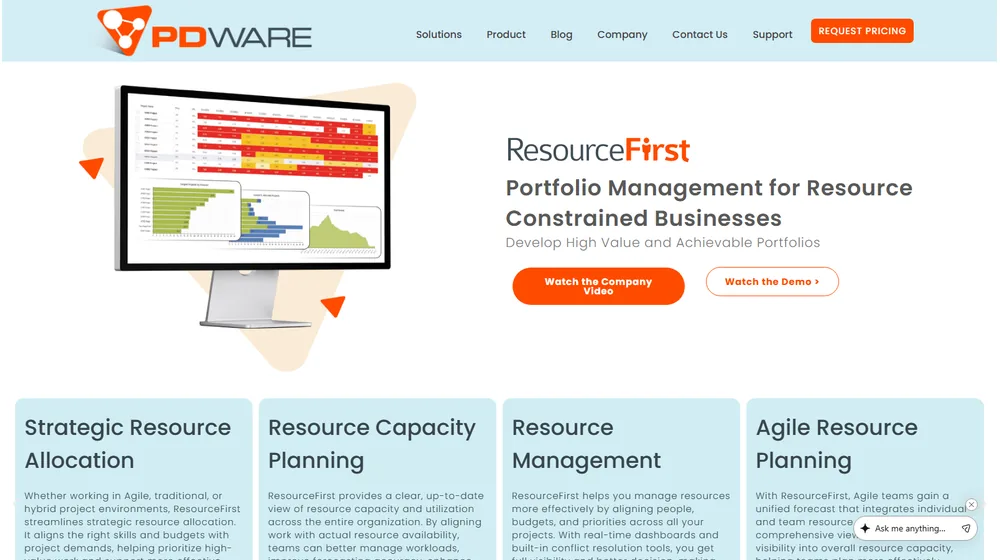
Key Features: Capability Breakdown
- Resource Allocation & Forecasting: Dynamic assignment, utilization tracking, and what-if analysis for multi-project environments.
- Portfolio Prioritization: Visual pipeline tools to weigh projects by impact, value, and resource load.
- Real-Time Reporting: Custom dashboards, KPIs, and automated updates for decision stakeholders.
- Integrations: Connects with Jira, MS Project, Finance/HRIS, and calendar tools for unified planning.
- Scenario Modeling: (2025+) AI-driven scenario analysis and predictive resource optimization.
- Role-Based Access Control: Secure, granular permissions for PMs, execs, and team leads.
- Low-Code Workflow Builder: Quickly tailor processes without IT intervention (Enterprise tiers).


Workflow & User Experience
- Intuitive, no-code UI with drag-and-drop resource grids.
- Guided onboarding wizards help SMBs migrate existing projects/teams rapidly.
- Pre-built templates for recurring PMO functions—saves setup effort.
- Role-aware dashboards auto-surface relevant indicators/focus areas per user type.
- Multi-device responsive design, with secure SSO and MFA for enterprise clients.
PDWare Pricing
| Plan | Core Features | Pricing |
|---|---|---|
| Professional | Resource allocation, basic reporting, Jira/MSP integrations, 10 users | $29/user/mo |
| Business | Portfolio prioritization, advanced dashboards, custom fields, 25 users | $49/user/mo |
| Enterprise | AI scenario modeling, low-code builder, SSO, priority support, unlimited users | Custom Quote |
PDWare vs. Alternatives
| Feature | PDWare | Smartsheet | Planview | Resource Guru |
|---|---|---|---|---|
| Resource Planning | Advanced, scenario-driven | Basic | Robust | Simple |
| Portfolio Analytics | Customizable | Limited | Comprehensive | None |
| Integrations | Jira, MS Project, HRIS | Wide | Broad | Basic |
| Setup/Usability | No-code, easy onboarding | Spreadsheet-like | Complex | Intuitive |
| AI/Automation | Roadmap: Predictive AI | No | Parts | No |
| Best For | SMBs, consulting, IT | General business | Enterprises | Agencies, freelancers |
Pro Tip: If your team outgrows spreadsheets but enterprise suites feel overwhelming, PDWare offers a focused middle ground—scalable without complex re-training or IT headaches. Test-drive with a pilot group before committing to full rollout.

Integrations
- Jira & Azure DevOps (bi-directional task/project sync)
- MS Project (import/export)
- Gmail & Outlook calendar overlays
- HRIS and financial tools for workforce/cost analytics (Enterprise tier)
Pros & Cons
| Pros | Cons |
|---|---|
|
|
Final Thoughts
PDWare stands out by balancing depth and simplicity, making robust resource portfolio management accessible to smaller teams and mid-size businesses previously underserved by the crowded PPM market. With a clear roadmap and an open approach to integrations, it is well positioned to capture organizations that need agility and clarity without enterprise-level bloat. For SMB PMOs, consulting, and IT service firms, it’s a compelling alternative—particularly as it evolves toward AI-powered scenario planning by 2026.
PDWare FAQ
Yes, it meets GDPR standards and supports HIPAA via a signed BAA on eligible plans.
Yes, white-label portals support your domain, favicon, and brand visuals.
Ideal for consultants, service firms, and SMBs needing streamlined collaboration.
No—integrates with both. Stripe powers payments; QuickBooks handles accounting.
All plans include chat/email; premium tiers add onboarding and 1:1 setup help.