

Mailchimp stands as a mainstay in the marketing automation landscape, continually evolving to meet the demands of entrepreneurs, small business owners, and growing SaaS brands. With industry trends pointing towards integrated, AI-driven campaigns and more granular analytics through 2026, Mailchimp positions itself as the platform of choice for teams wanting robust, scalable automation without the complexity or developer overhead typically found in enterprise tools.
From Launch to 2026: The Mailchimp Evolution Timeline
- 2001–2018: Bootstrapped growth as a leader in intuitive email marketing, expanding gradually into broader campaign management.
- 2019: Major pivot to an all-in-one marketing platform, adding landing pages, ads, and CRM features.
- 2021: Acquisition by Intuit, turbocharging integrations with accounting/commerce apps and accelerating product updates.
- 2023: Launch of enhanced AI tools for content, advanced segmentation, journey mapping, and predictive analytics.
- 2024–2026 (projected): Focused expansion into omnichannel orchestration, advanced automations, personalized e-commerce, and deeper vertical integrations. More visual, no-code UX and smarter reporting anticipated.
Key Features: Mailchimp’s Core Capabilities
- Automated Campaigns: Easily create and schedule drip emails, behavioral triggers, and customer journeys using intuitive visual workflows.
- Segmentation & Personalization: Powerful tools for segmenting lists by behavior, ecommerce data, and lifecycle stage; real-time dynamic content rendering for tailored messaging.
- Omnichannel Marketing: Beyond email—leverage integrated SMS, social media posting/ads, landing pages, popups, and postcards from one hub.
- AI-powered Tools: Content optimizers, send-time predictions, smart subject line suggestions, and product recommendations for ecommerce.
- Analytics & Reporting: Real-time dashboarding, custom reports, campaign comparison, predictive analytics, and GDPR/CCPA compliance features.
- CRM Features: Basics like audience profiles, tags, signup forms, and lead scoring to complement email and marketing automations.


Workflow and User Experience
- Clear, drag-and-drop campaign builder—minimal setup required.
- Persona-based templates for newsletters, product launches, and e-commerce promotions.
- Multi-user collaboration with granular permission controls.
- Mobile app for on-the-go automation and reporting.
- Step-by-step onboarding and guided help center for non-technical users.
Mailchimp Pricing
| Plan | Best For | Pricing (USD) |
|---|---|---|
| Free | Individuals & side-hustles; up to 500 contacts | $0/month |
| Essentials | Basic automation, A/B testing, support | From $13/month |
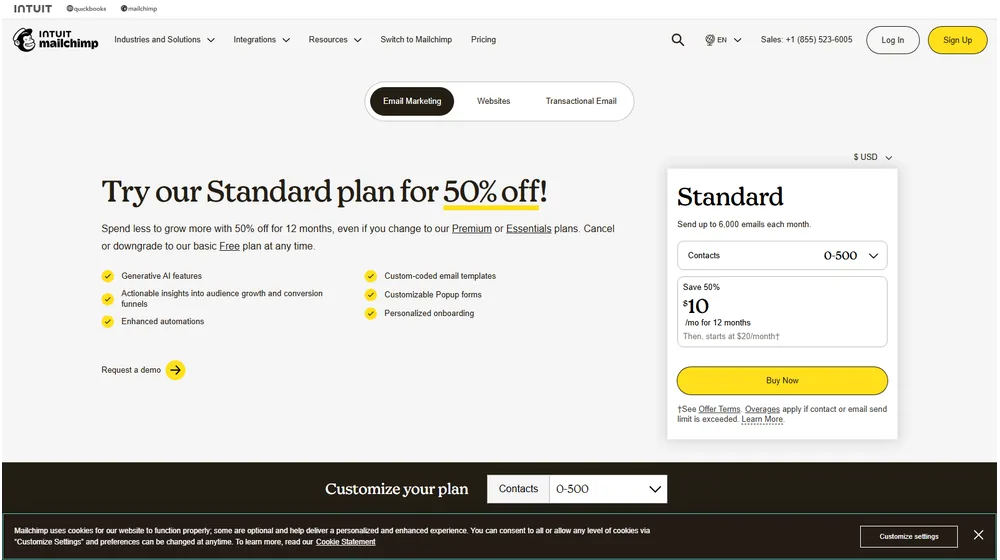
| Standard | Growing SMBs; advanced automations & analytics | From $20/month |
| Premium | Large lists, multivariate testing, priority support | From $350/month |
Mailchimp vs Competitors
| Platform | Key Differentiator | Best For |
|---|---|---|
| Mailchimp | All-in-one, intuitive UX, large app ecosystem | Most SMBs/startups |
| ActiveCampaign | Deeper sales/CRM automations | Sales-centric teams |
| ConvertKit | Creator-focused, simple automations | Creators/newsletters |
| Klaviyo | Powerful ecommerce automations | Shopify stores |
| HubSpot | Enterprise CRM, powerful segmentation | Midsize–large orgs |
Pro Tip: When launching, leverage Mailchimp’s AI-powered segment builder to test multiple subscriber slices—you’ll reveal high-engagement segments you’d likely miss on pure gut instinct.

Integrations
- Direct connections to Shopify, WooCommerce, Stripe, QuickBooks, Squarespace, Zapier, and hundreds more via API or Zapier.
- Sync contacts, automate abandoned cart emails, record purchase events directly to CRM.
- Third-party app marketplace supports ecommerce, lead generation, and accounting/CRM extensions.
Pros & Cons
| Pros | Cons |
|---|---|
|
|
Final Thoughts
For startups and SMBs seeking a reliable platform that balances usability with powerful features, Mailchimp continues to set the standard. Its roadmap through 2026 puts emphasis on deeper platform integrations and even more automation—assuming ongoing innovation, it remains a strong first choice, especially if your stack includes ecommerce or accounting integrations. Compare your needs with alternatives if you require enterprise CRM or highly specialized automation, but Mailchimp’s blend of cost, features, and ecosystem is tough to beat for the vast majority of business owners.
Mailchimp FAQ
Yes, Mailchimp meets GDPR standards and can support HIPAA requirements on select eligible plans with appropriate agreements.
Yes, Mailchimp allows white-labeled portals and use of custom domains for landing pages and branded communications.
Mailchimp is designed for startups, consultants, SMBs, and small teams prioritizing ease of use and integrated marketing.
No; Mailchimp integrates with payments (Stripe) and accounting (QuickBooks), extending rather than replacing those systems.
All paid plans include email/chat support; Premium tiers add phone support and personalized onboarding.