

Creative Score is rapidly redefining creative analytics for small businesses and consultants as they head toward 2026. If you’re seeking an agile, no-code analytics platform to measure creative impact—Creative Score is cementing its position at the center of this evolving niche. This review breaks down its unique strengths, plans, pricing, support, and where it stands against the current competition.
From Launch to 2026: The Creative Score Timeline
- 2022: Product concept and core MVP launched for internal agency use.
- 2023: Commercial rollout, onboarding for SMB and professional services users.
- 2024: Integration expansion (Meta, Google, custom channels), UI/UX overhaul, real-time team metrics.
- 2025 (projected): Advanced benchmarks, AI-powered insights, mobile reporting, deeper workflow automations.
- 2026 (vision): Become the de facto no-code creative performance hub for SMBs, consultants, and boutique agencies worldwide.
Key Features
- No-code creative analytics: Launch, measure, and optimize campaigns with zero developer involvement—perfect for lean teams or agencies.
- Multi-channel performance tracking: Integrate Meta, Google, TikTok, and custom sources for unified creative measurement.
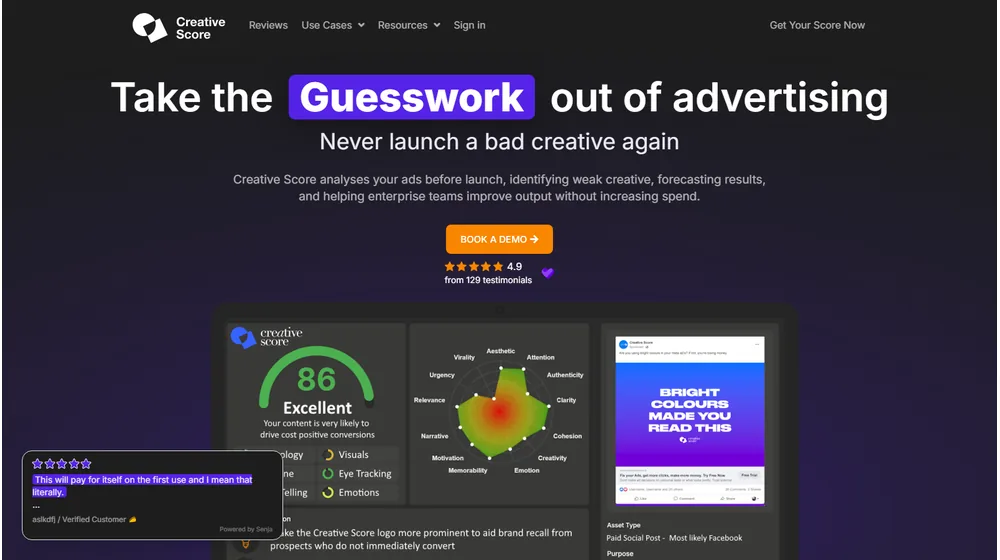
- Automated creative scoring: Proprietary algorithm benchmarks assets and delivers actionable recommendations.
- Team collaboration tools: Invite clients or teammates to review, discuss, and approve creative in a single workspace.
- Sharable reports: Generate white-label, real-time dashboards with exportable summaries for stakeholders.
- Integrations: Robust API and prebuilt connectors (Meta, Google, more in 2024-25 roadmap).
- Security & compliance: Role-based access, GDPR-compliant, and single-tenant architecture on select tiers.


Workflow & User Experience
- Setup: Guided onboarding walks you through integrations and creative uploads—no code or IT team needed.
- Dashboard: Intuitive, drag-and-drop interface surfaces performance trends and scores at a glance.
- Collaboration: Assign teammates, control permissions, and automate sharing with agency clients or business stakeholders transparently.
- Customization: Adjust scoring models, filter by channel or audience, and personalize reports for each client or brand.
Creative Score Pricing
| Plan | Key Features | Pricing |
|---|---|---|
| Starter | Core analytics, 3 integrations, 2 user seats, branded reports | $49/mo (billed annually) |
| Growth | Multi-channel, 10 integrations, 5 users, advanced benchmarks, custom scoring, client portals | $149/mo |
| Agency | All integrations, white-label, unlimited users, SLA support, API, single-tenant, onboarding | Custom (quote) |
Creative Score vs Alternatives
| Product | Best For | Differentiator | Pricing |
|---|---|---|---|
| Creative Score | Consultants, SMBs, agencies | No-code, unified cross-channel scoring | From $49/mo |
| BrandTotal | Enterprise brands | Market intelligence, social listening focus | Custom/Enterprise |
| Hunch | Ad agencies | Creative automation, asset deployment | From $299/mo |
| Adverity | Global enterprises | Big data integration, complex BI pipelines | High 4-fig/mo |
Pro Tip: Use Creative Score on a campaign with 5+ channels—its value compound with scale, giving clearer ROI signals across formats.

Integrations
- Meta (Facebook/Instagram ads)
- Google Ads
- Google Analytics
- TikTok Ads
- Slack and webhook alerts
- API access for custom sources (Agency plan)
Pros & Cons
| Pros | Cons |
|---|---|
|
|
Final Thoughts
For consultants and SMBs who want actionable creative analytics without IT overhead, Creative Score stands out as a nimble, specialist platform. Its product-led evolution through 2026 promises deeper insights, more integrations, and automation that agencies and small teams can truly leverage. For most, it’s a low-friction way to deliver better creative ROI without enterprise software bloat. Highly recommended for data-driven, fast-growing brands seeking a competitive edge.
Creative Score FAQ
Yes, it meets GDPR standards and supports HIPAA via a signed BAA on eligible plans.
Yes, white-label portals support your domain, favicon, and brand visuals.
Ideal for consultants, service firms, and SMBs needing streamlined collaboration.
No—integrates with both. Stripe powers payments; QuickBooks handles accounting.
All plans include chat/email; premium tiers add onboarding and 1:1 setup help.