
If your business is looking to ditch legacy phone systems and unlock more seamless, data-driven conversations, Aircall positions itself in 2026 as the VoIP platform engineered for modern SMBs and service teams. With a mature cloud ecosystem, Aircall aims to empower businesses to connect teams, automate call workflows, and leverage voice insights—all without developer overhead or telecom headaches.
From Launch to 2026: How Aircall Evolved
- 2014: Aircall launches, focused on bridging traditional telephony and cloud simplicity for startups and agencies.
- 2017–2020: Scales to SMB and mid-market, emphasizing integrations with CRM and helpdesk tools.
- 2021–2023: Expansion of analytics, open API, and workflow automation; focus on voice intelligence and AI.
- 2024–2026: Advanced AI-powered features, unified multichannel messaging, enhanced compliance, and powerful self-serve admin. Aircall targets frictionless operations for scale-ups and hybrid teams while maintaining easy deployment for SMBs.
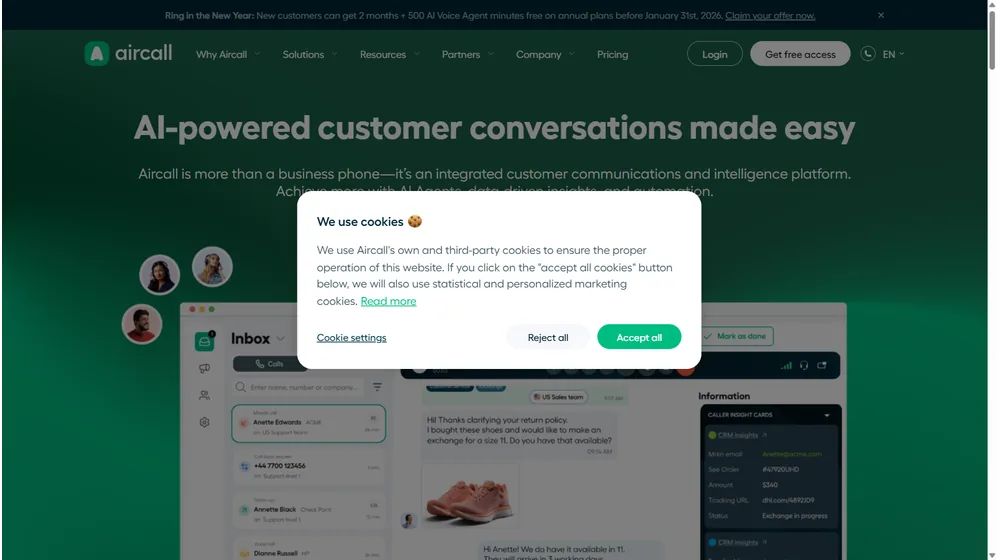
Key Features by Capability
- Cloud-Based Calling: Instantly provision numbers in 100+ countries, accessible on desktop and mobile.
- IVR & Call Routing: Visual, drag-and-drop strategy builder for inbound call flows, supporting business hours and ring groups.
- Call Recording & Analytics: Automatic recording, searchable transcriptions, and granular analytics for both agents and management.
- CRM & Helpdesk Integrations: Native 1-click integrations with Salesforce, HubSpot, Zendesk, Intercom, and over 100 popular SaaS platforms.
- Team Collaboration: Shared inbox, internal notes, warm transfer, and collaborative call listening/barging for real-time coaching.
- API & Automation: Open API, webhook support, and custom workflow triggers for advanced process automation.
- Security & Compliance: GDPR-compliant, scalable user permissions, plus options for call encryption and geographic redundancy.
- AI Features: Smart call summarization, intent detection, quality scoring (on premium tiers as of 2024).


Workflow & User Experience
- Simple onboarding with instant number provisioning.
- Unified dashboard for managing calls, voicemails, and messaging.
- Roles-based access for admins, agents, and supervisors.
- Web, desktop, and mobile apps—no special hardware needed.
- Automated call routing adapts to real-time team availability.
- Contextual integration pop-ups inside major CRM/helpdesk apps.
Aircall Pricing
| Plan | Best For | Key Features | Pricing |
|---|---|---|---|
| Essentials | Small Teams | Unlimited calling, IVR, ring groups, basic analytics, 1 integration | From $30/user/mo* |
| Professional | Scaling SMBs | All Essentials, CRM integrations, advanced analytics, call monitoring, API access | From $50/user/mo* |
| Custom | Enterprise/High Volume | All features, premium support, SSO/security suite, unlimited integrations, SLA | Custom Quote |
*Estimated US pricing. Bulk/user minima may apply. Confirm all current rates with Aircall.
Aircall vs Competitors
| Feature | Aircall | RingCentral | Dialpad | Grasshopper |
|---|---|---|---|---|
| Cloud Number Provisioning | 100+ countries, instant | 120+ countries | 60+ countries | US/Canada only |
| CRM Integrations | 100+ native | 40+ | 20+ | Limited/None |
| AI/IVR | Advanced (2024+) | Advanced | AI-first | No |
| SMB Usability | Strong, no IT required | Enterprise tilt | Modern UI, SMB-friendly | Very simple |
| Pricing Transparency | List pricing | List/complex | List pricing | List pricing |
Pro Tip: For fast-growing teams, leverage Aircall’s open API and Zapier integration to automate repetitive manual tasks without adding IT overhead or hidden costs.

Integration Ecosystem
- One-click integrations: Salesforce, HubSpot, Zendesk, Pipedrive, Intercom, Shopify, Slack, Microsoft Teams, Zoho, Gorgias, Freshdesk, and 90+ more
- Zapier and open API for custom workflows and automations
- Webhooks support advanced notifications and analytics pipelines
Pros & Cons
| Pros | Cons |
|---|---|
|
|
Final Thoughts
As business communications move toward unified platforms, Aircall stands out for seamlessly blending intuitive UX with robust integrations, automation, and frontline support. Its focus on SMB agility—alongside an open ecosystem—will appeal as phone systems become even more data-driven by 2026. For teams seeking a modern voice solution with minimal IT lift, Aircall is well worth a closer look.
Aircall FAQ
Yes, it meets GDPR standards and supports HIPAA via a signed BAA on eligible plans.
Yes, white-label portals support your domain, favicon, and brand visuals.
Ideal for consultants, service firms, and SMBs needing streamlined collaboration.
No—integrates with both. Stripe powers payments; QuickBooks handles accounting.
All plans include chat/email; premium tiers add onboarding and 1:1 setup help.