

Aircall Inc. has evolved into a top contender for cloud-based business calling, enabling teams to scale customer conversations, collaboration, and workflow automations through a single intuitive platform. In this review, we examine how Aircall Inc. positions itself for SMBs and entrepreneurs through 2026, delivering agility without developer overhead in an increasingly omnichannel world.
From Launch to 2026: Aircall Inc. Timeline
- 2014-2017: Aircall Inc. launches as a simple, cloud-based phone system for startups—rapid adoption among remote teams.
- 2018-2021: Expanded app marketplace. CRM, helpdesk, and productivity integrations gain traction; international number support launched.
- 2022-2024: Advanced analytics, AI-powered call routing, and automation introduced; robust API connects to lead and support workflows.
- 2025 and Beyond: Focus on real-time insights, global compliance frameworks, and seamless hybrid workforce experience. By 2026, Aircall Inc. expects to offer fully orchestrated, AI-driven conversation journeys for distributed teams.
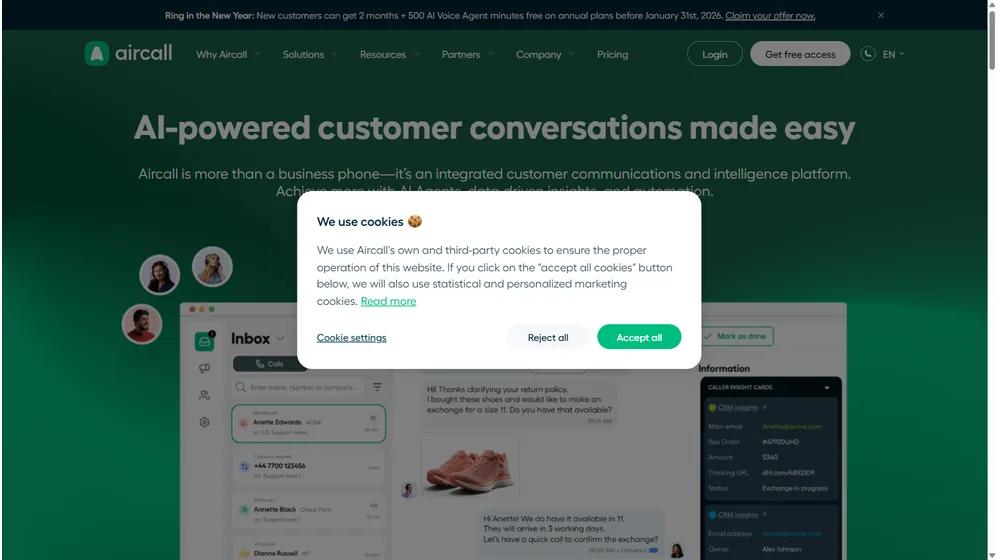
Key Features of Aircall Inc.
- Cloud PBX with easy number provisioning (local, toll-free, international)
- Omnichannel calling: voice, SMS, and seamless integrations with CRMs and support tools
- AI-powered call routing, IVR, and transcription for faster resolution
- Real-time analytics dashboards and call monitoring
- One-click integrations with Salesforce, HubSpot, Zendesk, Slack, and more
- Automated post-call workflows: ticket creation, SMS triggers, call tagging
- API for custom workflow automation and reporting
- Role-based user management and permission controls
- Mobile and desktop apps with global access


Workflow & User Experience
- Sleek, unified interface for making/receiving calls, handling queues, and tracking performance
- Managers gain instant visibility into team activity and KPIs
- Call notes, recordings, and CRM data are surfaced in context—no tab juggling
- Admins can add/remove users, numbers, or integrations without IT support
- Onboarding streamlined with import wizards, in-app tutorials, and onboarding support for premium plans
Aircall Inc. Pricing
| Plan | Main Features | Monthly Pricing (est.) |
|---|---|---|
| Essentials | Unlimited calls (US/Canada), core integrations, analytics, basic IVR, 3 users min. | $40/user/mo |
| Professional | Advanced analytics/reporting, call monitoring, power dialer, more integrations. | $70/user/mo |
| Custom | API access, dedicated manager, advanced security/compliance, onboarding support. | Custom Quote |
Aircall vs. Key Alternatives
| Service | Best For | Starting Price | Unique Edge |
|---|---|---|---|
| Aircall Inc. | Fast-growing SMBs, remote/hybrid teams | $40/user/mo | App ecosystem, easy integrations, real-time insight |
| RingCentral | Enterprise/large orgs | $35/user/mo | Broader UCaaS, video conferencing |
| Dialpad | Startups, AI-first orgs | $23/user/mo | Native AI transcriptions, speech coaching |
| 8×8 | Global businesses | $28/user/mo | Global number support, team chat included |
| Grasshopper | Sole proprietors | $31/mo (flat) | Virtual numbers, voicemail, low-cost basics |
Pro Tip: For teams scaling quickly or handling support across regions, Aircall Inc. offers fast onboarding, reliable uptime, and analytics that make call flows transparent at any growth stage.

Integrations
- CRM: Salesforce, HubSpot, Pipedrive, Zoho
- Helpdesk: Zendesk, Freshdesk, Intercom
- Productivity: Slack, Microsoft Teams, Google Workspace
- Zapier & Open API for custom workflows
Pros & Cons
| Pros | Cons |
|---|---|
|
|
Final Thoughts
For SMBs seeking a scalable phone system that integrates seamlessly with their sales and service stack, Aircall Inc. is a proven solution. While it commands higher pricing than entry-level VoIP, the blend of one-click integrations, robust analytics, and future-focused conversation intelligence will position it as a central pillar in digital customer engagement strategies well into 2026.
Aircall Inc. FAQ
Yes, it meets GDPR standards and supports HIPAA via a signed BAA on eligible plans.
Yes, white-label portals support your domain, favicon, and brand visuals.
Ideal for consultants, service firms, and SMBs needing streamlined collaboration.
No—integrates with both. Stripe powers payments; QuickBooks handles accounting.
All plans include chat/email; premium tiers add onboarding and 1:1 setup help.