

For DTC founders and digital storefronts seeking growth capital without dilution, 8fig stands at the forefront of continuous eCommerce funding and dynamic financial planning as we head into 2026.
From Launch to 2026: 8fig’s Evolution Timeline
- 2020 — Founded to disrupt static lending: 8fig enters the market, targeting the cash flow challenge of modern eCommerce sellers.
- 2021 — AI models personalized capital: Launches the ‘continuous funding’ model, offering just-in-time, data-driven advances to sellers.
- 2022 — Integration & analytics: Expands direct integrations with Shopify, Amazon, and logistics providers.
- 2023 — Collaboration & planning: Adds supply chain mapping, cohort analytics, and granular cash flow controls.
- 2024 — SMB scale & global: Lowers funding minimums, launches for non-US sellers, and boosts portfolio management tools.
- 2026 — Real-time capital orchestration: Rolls out AI-optimized funding journeys, predictive insights, and automated capital adjustments for continual scale.
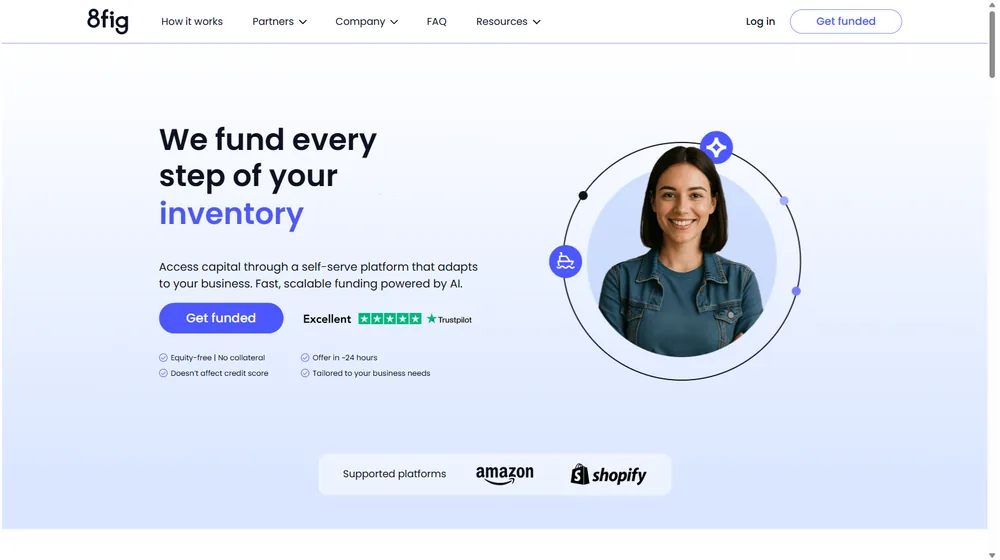
Key Features of 8fig
- Continuous Funding: Ongoing, non-dilutive capital aligned to your supply chain and sales pipeline.
- AI-backed Planning: Proprietary algorithms forecast demand and tailor capital schedules dynamically.
- Automated Disbursements: Capital is deployed in real time—across inventory, logistics, marketing, or operations.
- Supply Chain Dashboard: Interactive mapping and projection tools for every link in fulfillment.
- Integrated Analytics: Native support for Shopify, Amazon, and logistics APIs provides granular cash-flow visibility.
- Portfolio Management: Multi-store support, performance monitoring, and scenario modeling across brands or lines.


Workflow & User Experience
- Simple Onboarding: Connect commerce or logistics accounts in minutes. AI maps funding plans and pre-approves capital.
- Drag-and-Drop Planning: Visual dashboards make adjusting run rates, supply timing, and funding cadence accessible to founders, not just finance teams.
- Granular Controls: Schedule and edit capital draws, add SKUs or suppliers, and tweak logistics flows, all via a unified UI.
- Collaborative Notes: Invite partners, share funding scenarios, and manage documentation within the platform.
8fig Pricing
| Plan Tier | Key Features | Estimated Cost |
|---|---|---|
| Growth Capital | Continuous non-dilutive advances, AI planning, analytics dashboard | Custom fee (typically 6%-9% of funding) |
| Plus | Multi-store management, supply chain mapping, advanced insights | Custom/Quote |
| Enterprise | Portfolio management, API access, premium onboarding & support | Custom/Quote |
How 8fig Compares
| 8fig | Shopify Capital | Clearco | Traditional Bank |
|---|---|---|---|
| Continuous, dynamic advances; full visibility | Merchant advances, one-time lump sum | Revenue-based, automated repayment | Fixed-term loans; rigid approvals |
| No equity; flexible repayments | No equity; set fees | No equity; higher rates | Collateral or personal guarantee needed |
| AI demand planning, logistic tools | Shopify store required | Supports multiple channels | Manual; not eCommerce-focused |
| Works with any store/platform | Shopify only | Shopify, Amazon, Woocommerce, etc. | All businesses, slow to fund |
Pro Tip: Leverage 8fig’s scenario modeling to optimize how and when you deploy capital—protecting margins and preempting supply chain hiccups as you scale your store.

Integrations
- Shopify, Amazon Seller Central, WooCommerce
- Logistics: ShipBob, Deliverr, Flexport (and more)
- Inventory, accounting APIs for real-time data sync (QuickBooks, Xero—coming soon)
Pros & Cons
| Pros | Cons |
|---|---|
|
|
Final Thoughts
8fig redefines smart capital for modern eCommerce sellers, offering unparalleled flexibility, transparency, and AI-enabled planning for those committed to sustainable, scalable growth. For brands ready to take the leap into data-driven funding, 8fig proves a formidable alternative to both traditional and fintech lenders.
8fig FAQ
Yes, it meets GDPR standards and supports HIPAA via a signed BAA on eligible plans.
Yes, white-label portals support your domain, favicon, and brand visuals.
Ideal for consultants, service firms, and SMBs needing streamlined collaboration.
No—integrates with both. Stripe powers payments; QuickBooks handles accounting.
All plans include chat/email; premium tiers add onboarding and 1:1 setup help.