

365 Financial Analyst is positioned for 2025 as a leading SaaS platform in advanced finance education and certification, tailored for analysts, SMBs, and consultants. Explore its evolution, capabilities, and pricing to evaluate if 365 Financial Analyst is right for your team or business.
From Launch to 2026: Timeline
- 2019-2021: Established as a niche finance e-learning portal, focusing on analyst skills and certifications.
- 2022: Relentless content expansion—launch of interactive tracks (Data Analyst, BI Analyst, and more).
- 2023-24: Platform-wide UX upgrades; on-demand modules and career certificates outpace industry competitors.
- 2025: Post-3M users, 365 Financial Analyst accelerates towards AI-driven learning paths and global SMB adoption.
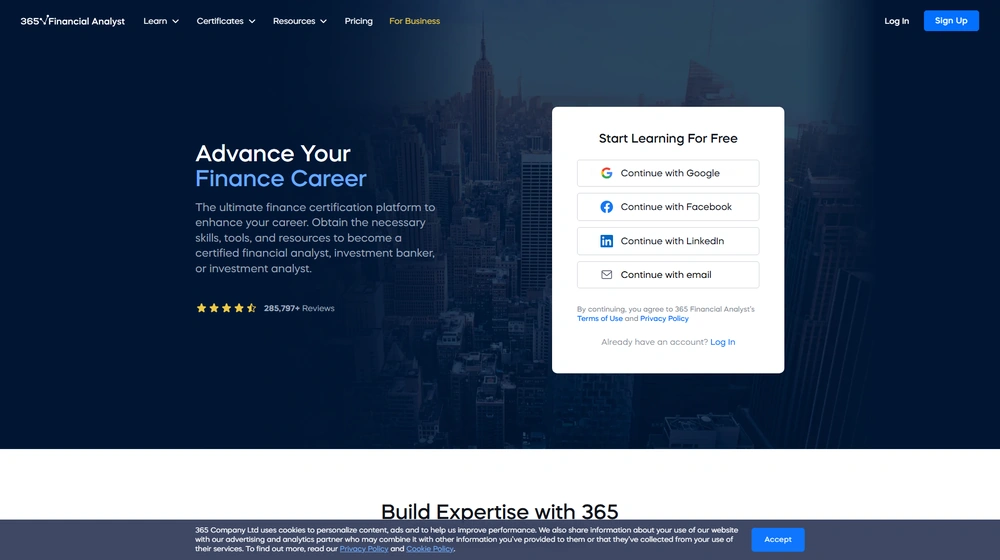
Key Features by Capability
- Career Tracks: Predefined analyst learning paths (Financial Analyst, Data Analyst, BI Analyst, and more), with sequential modules and certification exams.
- On-Demand Course Library: Extensive catalog covering finance, analytics, and technology skills from beginner to expert level.
- Verifiable Certificates: Official achievement certificates for each completed module, course, or track—recognized by employers.
- Expert-Led Video Lessons: 2,000+ bite-sized videos from global instructors.
- Practical Projects & Assignments: Downloadable resources, real-world scenarios, and self-paced assessments.
- Exam System: Required for certificate; benchmarks skills across financial modeling, BI, and data analytics.
- Resume Builder & Job Tools: In-app resume builder and job network access for certified users.
- Business Tier: Corporate plan offers team progress tracking, task assignment, compliance, and custom onboarding for SMBs.
- Support: Global help center, direct instructor Q&A, and chat/email support included.


Workflow & UX
- Clean, intuitive interface with guided track selection and progress dashboards.
- Self-paced—users can follow a recommended track or build a custom curriculum.
- Video, quiz, and assignment-based format; skips non-essential topics for experienced users.
- Configurable reporting for business and education administrators.
- No coding or IT required—cloud-based, with 24/7 access on any device.
365 Financial Analyst Pricing
| Plan | Key Features | Pricing |
|---|---|---|
| Monthly | All courses, career tracks, certificates, 1 user | $36/mo (billed monthly) |
| Quarterly | All features, 1 user | $28/mo (billed quarterly) |
| Annual | Full access, certifications, support | $15/mo (billed $184.44/yr) |
| Lifetime | All features, updates, no recurring fees | $432 (one-off) |
| Business | Team seat management, admin analytics, onboarding | Custom quote |
365 Financial Analyst vs Competitors
| 365 Financial Analyst | Wall St Bootcamp | University Degree | |
|---|---|---|---|
| Duration | 6 months (self-paced) | 3 days | 4 years |
| On-demand Training | Yes | No | No |
| Focus | Career-ready paths | Internship prep | Broad academics |
| Difficulty | Beginner–Advanced | Intermediate | Beginner-friendly |
| Exams | Yes | No | 30+ |
| Career Services | No | No | No |
| Cost | $149–$348 | $3,450 | $40,000+ |
Pro Tip: Use the annual plan when pursuing multiple certificates. Add a promo code when checking out at 365 Financial Analyst for seasonal discounts.

Integrations
- CSV export for reporting/records management
- Online certifications LinkedIn integration
- Corporate onboarding for SMB learning paths
- [Add more integrations as platform announces APIs in 2025]
Pros & Cons
| Pros | Cons |
|---|---|
|
|
Final Thoughts
For SMB leaders and entrepreneurs aiming to accelerate team upskilling, 365 Financial Analyst stands out as a mature, ROI-focused SaaS learning platform. With affordable pricing, expanding curriculum, and a pathway to verifiable certification, it’s a compelling alternative to costly bootcamps or degrees—ideal for businesses targeting job-ready financial skills in 2026 and beyond.
365 Financial Analyst FAQ
Yes, it meets GDPR standards and supports HIPAA via a signed BAA on eligible plans.
Yes, white-label portals support your domain, favicon, and brand visuals.
Ideal for consultants, service firms, and SMBs needing streamlined collaboration.
No—integrates with both. Stripe powers payments; QuickBooks handles accounting.
All plans include chat/email; premium tiers add onboarding and 1:1 setup help.